
Your network knows where your subscribers live, work, bank, and shop. Almost none of that value reaches the P&L.
For years, monetizing that signal came with a specific set of risks: moving raw subscriber data outside the perimeter, straining compliance, and committing to integration cycles measured in quarters. Those conditions have changed, and the change is what makes telecom data monetization a live commercial question in 2026 rather than a roadmap item.
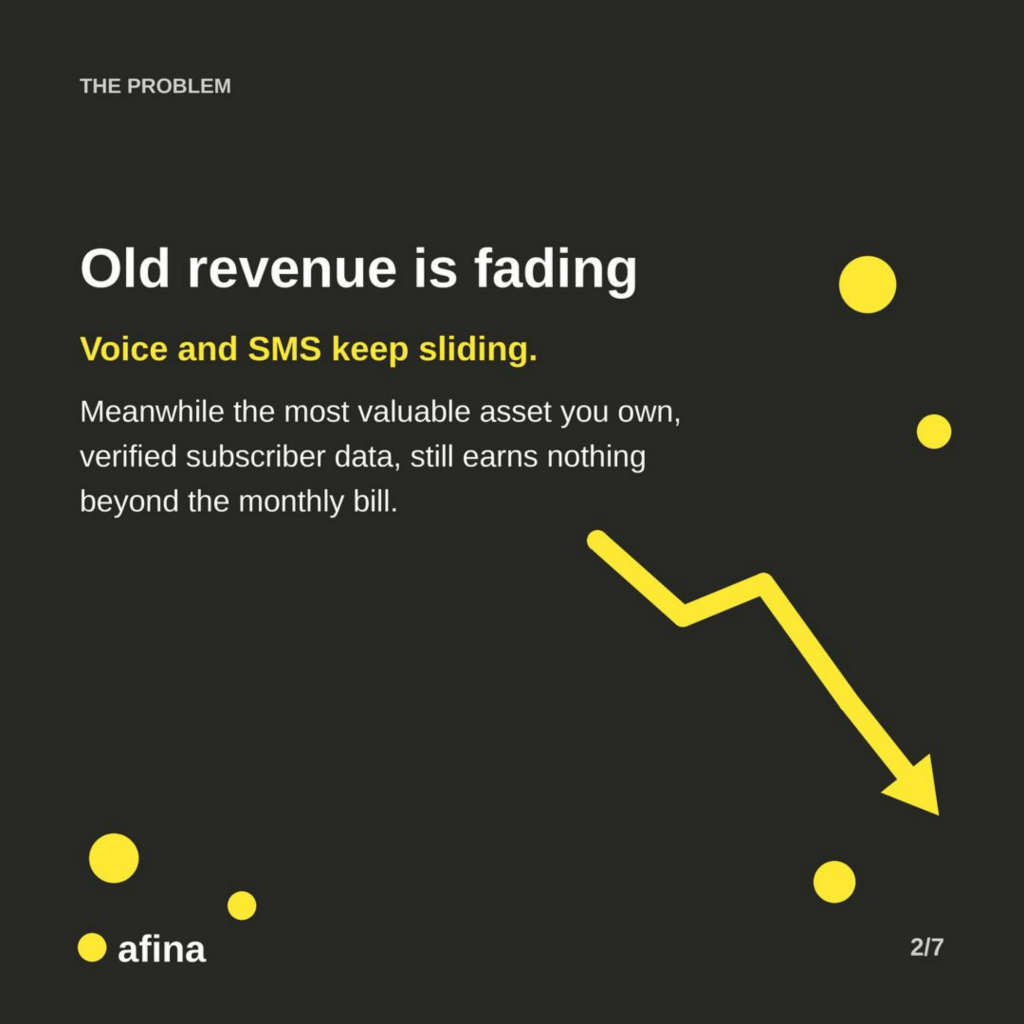
EY now sees mobile operators converging on two scalable routes to monetize network signal: first-party data products and Network APIs. The firm frames the underlying shift as a convergence of 5G, cloud-native cores, edge computing, and global API standardization, which together make telecom intelligence programmable and scalable for the first time. That combination moves operators from connectivity utilities toward intelligence platforms, with high-margin recurring revenue attached. EY sizes the telecom data market at $14.8 billion.
The demand side explains the timing. As third-party cookies lose value, consented first-party data becomes the scarce input the entire advertising market is bidding for. Operators already hold that input, verified at the network rather than inferred from browsing behaviour, and updated continuously across millions of subscribers.
What historically blocked this was the safety question. The data clean room, now treated as core infrastructure by the IAB Tech Lab, answers it directly: two parties combine their first-party data, insight comes out, and raw data never leaves the room. Privacy compliance stops functioning as a cost centre and starts functioning as the mechanism that makes the revenue possible at all.

That principle sets the 2026 dividing line for operators. Managing subscriber data with discipline is table stakes across the industry. The revenue sits in packaging it into products an enterprise buyer can actually purchase, with clear pricing, delivery, and governance around them.
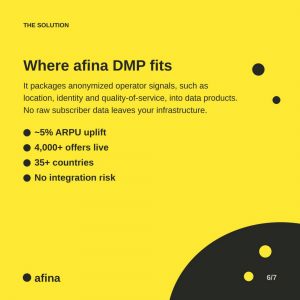
This is the layer afina DMP occupies. The platform packages anonymized operator signals, including location, identity, and quality-of-service, into data products that advertisers and enterprises can buy, with no raw subscriber data leaving the operator’s infrastructure.
For operators weighing where to start, the strategic question has narrowed considerably. The infrastructure is in place, the compliance mechanism exists, and the demand for consented first-party data is rising as alternative signals decay. What remains is a commercial decision about which route to build first and how quickly, because the operators who move early set the pricing and partnership structures that later entrants inherit.
Sources:
- EY, Telecom Data Monetization: Network APIs and AI Revenue (February 2026)
- Douglas B. Laney, Infonomics: How to Monetize, Manage, and Measure Information as an Asset for Competitive Advantage (Routledge, 2017)
- IAB Tech Lab, data clean room standards and guidance