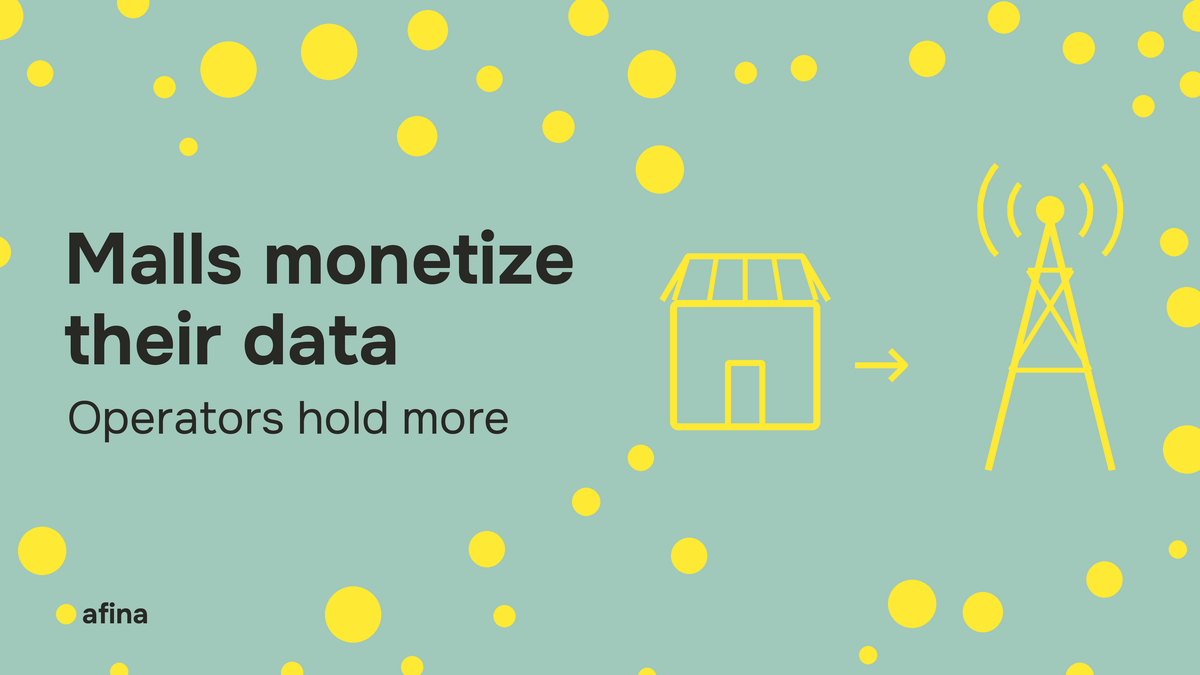
Malls and hardware stores are monetizing their data. Operators hold more.
Growth in large companies has shifted from invention to extraction. Gartner looked at 1,180 growth initiatives across more than 500 large companies in ten industries. Seven out of ten now go to monetization and platformization, meaning revenue drawn from data, capabilities and customer relationships a company already owns. Only 21% go to new products and services. Vaughan Archer of Gartner frames it as a shift “from value creation to value capture”.
Two companies outside telecom show what that looks like in practice.
A mall operator becomes a media network
Simon Property Group, the world’s largest shopping mall operator, launched Simon Media Network on three inputs it already had: the Simon+ loyalty program, opt-in Wi-Fi location data inside its malls and licensed partner purchase data. CRO Jared Blechman says the result is “much broader than the audiences of traditional retail media networks.”
Eric Lamb of Vistar Media explained to Digiday why this works: “Any physical environment where the owner has some level of relationship with the people walking in, and they have data about them, there’s an opportunity to influence them while they’re there.”
A hardware chain sells incrementality
Ace Hardware runs its own retail media network, RedVest Media, built on a loyalty base of about 80 million members. Its head, Molly Hjelm, named the question every advertiser now asks: “Everybody’s very interested in understanding the true incrementality that would not have happened absent the media.” She also described how Ace grows the network: “We’re expanding with intention.”
The market has moved past reach metrics. Buyers pay for proof that the media changed an outcome.
Why operators are better placed
Loyalty data, location data and partner transactions: an operator holds a denser version of all three, plus identity, billing and network quality of service. The signal covers almost the entire population of a country, not only the people who walk into a mall.
Operators can also measure incrementality in a way most retailers cannot. Signal, offer delivery and the subscriber’s response sit inside one perimeter, so the closed loop is already there.
Sovereignty now works in their favor too. GSMA Intelligence research finds enterprises are willing to pay around 13% more, on average, for technology that stays sovereign. For years, “the data cannot leave our perimeter” was the reason telecom data projects quietly died. It is turning into a price premium.
What is actually missing
When a mall operator and a hardware chain can build media businesses on thinner data than any telco holds, the gap is rarely technology. More often it is ownership: no one inside the operator owns the P&L for subscriber data.
afina DMP is built to close that gap inside the operator’s own perimeter. Anonymized network signals become packaged data products and targeted offers that a bank or a retailer can buy, and no raw subscriber data leaves the operator’s infrastructure. Participating operators see around +5% ARPU, with 4,000+ offers live across 35+ countries.
Value capture rewards the first mover twice: whoever moves first also sets the price others accept later.
Sources
Gartner, 27 Aug 2026, CFOs must prioritize platformization and monetization
AdExchanger, James Hercher, Simon Media Network, 27 Aug 2026
Digiday, Mitchell Parton, Simon location data (Eric Lamb), 2 Sep 2026
Digiday, Mitchell Parton, Ace Hardware RedVest Media (Molly Hjelm), 3 Sep 2026
GSMA Intelligence, technology sovereignty research (Aug 2026) and Global Enterprise Survey 2026